
COD return rates fall when every order is confirmed before dispatch. The six most effective steps are WhatsApp confirmation before packing, logging every customer response, blocking repeat offenders, tagging rider assignments, reviewing return metrics weekly, and personalising follow-up messages. Stores without verification commonly see 15-40% returns; verified stores typically reach single digits.
Return and cancellation rates are one of the quiet killers of COD profitability. Every returned parcel costs you shipping both ways, packaging, and a product sitting in your warehouse instead of a customer’s hands. The frustrating part is that most of these losses are predictable — and preventable. Here are six practical steps Shopify COD merchants can take to bring those numbers down.
1. Confirm Every Order Before You Pack It
The single biggest lever is verifying intent before fulfillment, not after. Sending an automatic WhatsApp confirmation the moment an order comes in — and waiting for a Yes before packing — filters out a large share of orders that would otherwise come back as returns. The customer either confirms, cancels cleanly before you spend anything, or goes silent and you hold the order rather than shipping blind.
The key is making this automatic, not manual. If confirmation depends on a staff member remembering to send a text, it will be missed during busy periods — which are exactly when order volume and fake-order risk are highest.
2. Track Every Response in One Place
Logging every response — order number, customer name, phone, status, and timestamp — means your fulfillment team always knows which orders are safe to process and which are still pending. Without a central log, confirmed orders get mixed with unconfirmed ones, and the operational confusion itself causes errors: wrong orders packed, confirmed orders delayed, cancelled orders shipped anyway.
Real-time response tracking also makes it easy to spot patterns. If a specific time of day or product type generates a high no-response rate, you can see it and act on it.
| Measure | Without verification | With WhatsApp confirmation |
|---|---|---|
| Return and cancellation rate | Commonly 15-40% | Commonly under 10% |
| When fake orders are caught | After shipping, once the parcel returns | Before packing, at no shipping cost |
| Repeat offenders | Order again undetected | Flagged and blocked automatically |
| Confirmation effort | Manual calls and messages | Automated, replies logged to the order |
| Cost of a failed order | Two-way shipping, packaging, staff time | Effectively zero |
3. Flag and Block Repeat Offenders
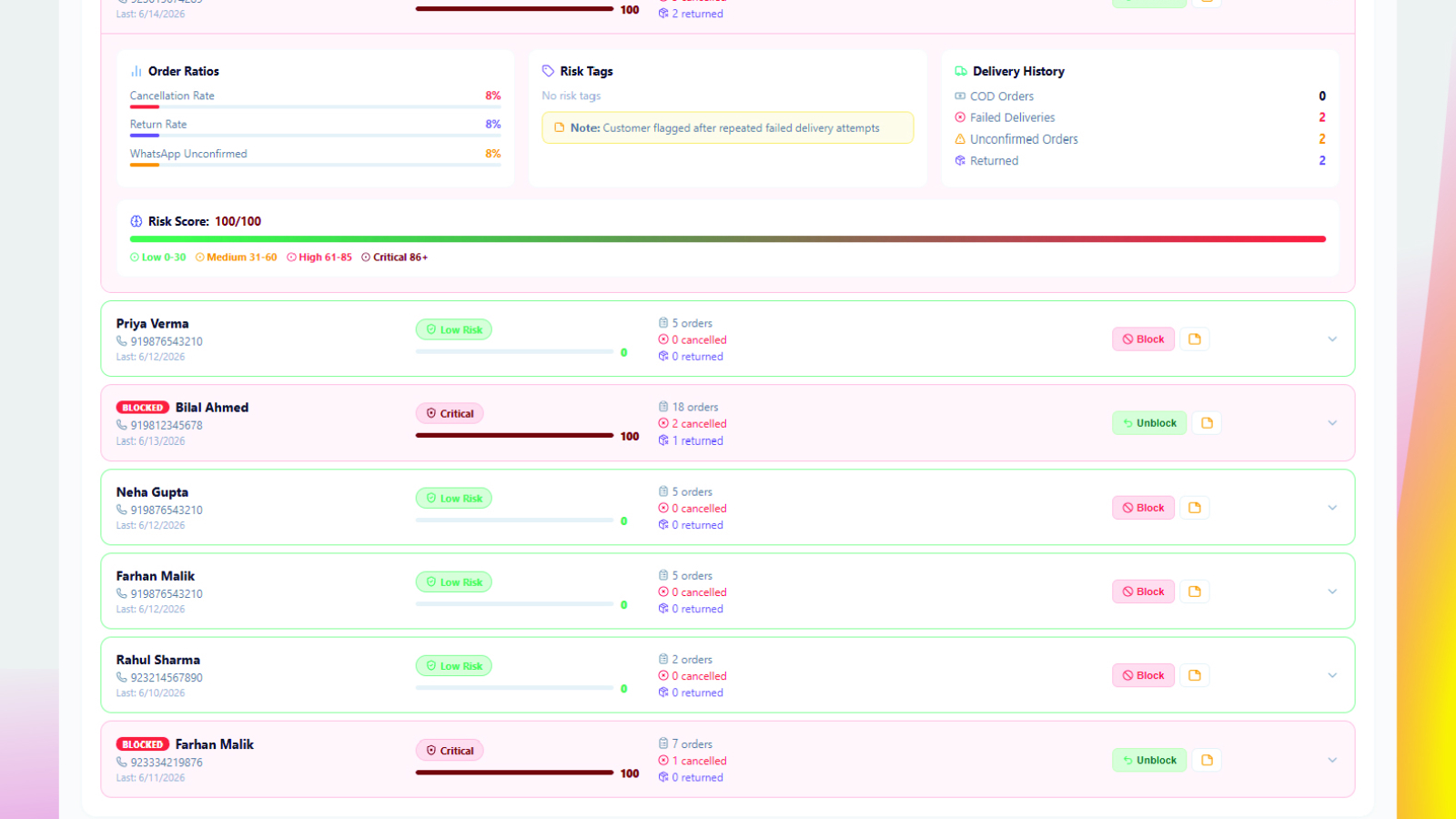
A small number of customers are usually responsible for a disproportionate share of cancellations and returns. Reviewing order history for repeated cancellations, adding internal staff notes, and blocking those customers outright stops the same pattern from repeating order after order. ConfirmQ’s fake order detection scores customers by risk based on their history — cancellation rate, return rate, and total orders — making it straightforward to identify who to block before the next order ships.
If a blocked customer tries to order again, your team receives an instant WhatsApp alert, giving you the final say on whether to process it. One blocked repeat-offender can save you more than their entire order history in combined shipping and return costs.
4. Use Rider Assignment Tags to Cut Delivery Errors
A meaningful share of “returns” are really delivery failures — wrong rider, wrong address, nobody available at delivery, no follow-up when the first attempt failed. Tagging orders with the assigned rider (for example, “Rider: Ali”) inside Shopify keeps accountability clear and makes it obvious who is responsible for each parcel. When a delivery fails, you know immediately who handled it and can address it directly.
ConfirmQ’s Shipments section lets you assign and update riders, change order status, and send WhatsApp delivery updates to customers with one click — reducing the communication gaps that turn delayed deliveries into full returns.
5. Watch the Numbers, Not Just the Orders
It is hard to fix what you cannot see. Tracking cancellations, returns, and the actual rupee or dollar cost of both — alongside confirmed orders and revenue — in one report makes it obvious when a return rate is creeping up, instead of noticing it three months later in your margins. ConfirmQ’s Reports & Analytics section tracks all of this and lets you export the full picture to Excel in one click for deeper analysis or sharing with your team.
Pay particular attention to cancellation losses and return losses as separate line items. Knowing which is higher tells you whether your primary problem is pre-shipment (fake/impulsive orders) or post-shipment (delivery or product issues) — and the fix for each is different.
6. Personalize Follow-Ups Instead of Using Generic Templates
Generic, obviously automated messages get ignored. A WhatsApp message that addresses the customer by name, references their specific order number and items, and comes from a recognizable number gets read and responded to — which means more customers actually confirm instead of leaving an order in limbo until it is cancelled or returned at the door. ConfirmQ lets you customize every message template so your confirmation, cancellation, and fulfillment messages sound like your brand, not a mass-messaging platform.
How Much Can This Actually Move the Needle?
The impact depends on your current return and cancellation rates, but the mechanics are straightforward. If you are processing 100 COD orders a day with a 20% unconfirmed-or-cancelled rate, automating confirmation and blocking five chronic returners per month can meaningfully reduce both your shipping spend and your returns backlog. The numbers compound quickly because you are not just saving on individual parcels — you are reclaiming the staff time that was going into manual follow-up on every one of those orders.
Put It Into Practice
ConfirmQ handles all six of these directly — automatic WhatsApp confirmation, response logging, fake order detection and customer blocking, rider assignment and shipment tracking, and detailed reports showing your actual cancellation and return costs. View pricing or install directly from the Shopify App Store.
Install ConfirmQ on the Shopify App Store →
Frequently Asked Questions
COD return rates in markets like Pakistan, India, and the Middle East typically range from 15% to 40% for stores without an order verification system. With WhatsApp confirmation and customer blocking in place, merchants commonly bring this below 10%.
The most effective method is confirming every order via WhatsApp before packing. When customers must actively reply to confirm, impulsive or fraudulent orders are filtered out at zero cost. Combine this with flagging and blocking repeat offenders for the best results.
Yes. WhatsApp confirmation ensures the customer genuinely intended to place the order. Delivery update messages via WhatsApp also reduce failed deliveries by keeping customers informed, which is one of the main causes of returns.
ConfirmQ tracks cancellations and returns per customer. When a customer hits your defined threshold, you can block them directly in ConfirmQ. If they attempt to place a new order, your admin team receives an instant WhatsApp alert so you can decide whether to process it.
ConfirmQ is specifically built to reduce COD return rates through WhatsApp order confirmation, customer risk scoring, automated follow-ups, and rider assignment tracking. It addresses every stage of the COD fulfillment cycle where returns typically occur.

