
RTO (Return to Origin) is a parcel that ships, fails to be delivered, and travels back to your warehouse unpaid. It rises when orders are dispatched without the customer ever confirming them, when delivery windows are unclear, and when repeat offenders are allowed to keep ordering. The fastest way to reduce RTO is to verify buyer intent on WhatsApp before dispatch, keep customers informed during delivery, and block customers with a history of refusals.
Every cash-on-delivery merchant knows the feeling. A parcel goes out on Monday. On Friday it comes back, slightly battered, still sealed, and you have paid shipping in both directions for the privilege.
That is RTO, and for COD stores in Pakistan, India, Bangladesh and the Gulf it is usually the single largest uncontrolled cost in the business. Not ad spend. Not COGS. The parcels that came home.
The frustrating part is that RTO tends to get worse as a store grows. This guide explains why that happens, what an RTO parcel genuinely costs you, and which methods actually move the number — ranked by how much difference they make.
What RTO Actually Means (And Why It Is Not Just a Return)
RTO stands for Return to Origin. The courier attempted delivery, could not complete it, and shipped the parcel back to you. The customer never accepted it and never paid.
People use RTO and “return” interchangeably, but they are different problems with different fixes:
| RTO | Customer return | |
|---|---|---|
| What happened | Delivery failed or was refused | Delivery succeeded, buyer changed mind |
| Did you get paid? | No, never | Yes, then refunded |
| Root cause | Intent, contact, or timing failure | Product, sizing, or expectation failure |
| Where to fix it | Before dispatch | On the product page |
This distinction matters because most merchants respond to rising RTO by improving product photos and size charts. That is the fix for returns. RTO is almost always a pre-dispatch problem, and it has to be solved before the parcel leaves the building.
What One RTO Parcel Really Costs
Merchants tend to price an RTO as “a lost sale.” It is considerably worse than that, because a lost sale costs nothing and an RTO costs money in six places at once.
- Forward shipping — already paid, non-recoverable.
- Return shipping — most couriers charge for the return leg, sometimes at full rate.
- Packaging — the box, filler and labels are gone.
- Handling time — someone picked, packed, dispatched, then received and restocked it.
- Inventory lock-up — that unit was unavailable to a real buyer for one to two weeks.
- Product condition — some items come back unsellable after two trips through a courier network.
Work through the arithmetic on your own numbers and it becomes uncomfortable quickly. If your average order carries a gross margin of PKR 900, and an RTO parcel costs you roughly PKR 550 in shipping, packaging and handling, then every RTO wipes out the profit from a delivered order and takes a bite out of the next one.
At a 25% RTO rate, one in four parcels is not merely earning nothing — it is actively consuming the margin from the three that succeeded. This is the mechanism behind stores that grow revenue every month while the bank balance goes sideways. If you have never put a figure on it, our guide to measuring what COD cancellations and returns actually cost walks through the full calculation.
Why RTO Increases
RTO is rarely one problem. It is usually five small leaks that compound, and they get worse with scale because the manual checks that worked at 20 orders a day quietly stop happening at 200.
1. Orders ship without the customer ever confirming them
This is the largest single cause. COD has no payment step, so there is no moment where the buyer commits to anything. Clicking “Order” on a COD checkout costs a customer nothing — no card, no deduction, no consequence. A meaningful share of those clicks are curiosity, comparison shopping, or a decision that was already regretted by the time you packed the box.
If nobody asked the customer “do you still want this?” before dispatch, you are shipping on an assumption.
2. Paid traffic brings lower-intent buyers
This is why RTO often spikes right after a store scales its ad spend. Broad interest-based campaigns and impulse-driven creative generate orders from people who were not actively shopping. Those orders convert well and deliver badly. The campaign dashboard shows a great cost per purchase; the courier report shows the truth two weeks later.
3. The customer is unreachable at delivery
Wrong digit in the phone number, an incomplete address, a rider who calls once during working hours and moves on. The buyer genuinely wanted the product and still never received it. These are the most painful RTOs because the sale was real and it was lost to logistics.
4. Delivery takes longer than the buyer expected
Enthusiasm decays. A parcel that arrives on day three is usually accepted. The same parcel arriving unannounced on day nine, after the customer has forgotten ordering it or bought the item locally, gets refused at the door. Silence during the delivery window is what turns a keen buyer into a refusal.
5. Repeat offenders are never identified
In most COD stores, a small group of phone numbers accounts for a disproportionate share of refused parcels. They order, they refuse, and because nothing in Shopify links a customer to their delivery history, they order again next month and you ship again. Without a record, the same buyer can cost you five RTOs before anyone notices a pattern. The nine warning signs of a fake Shopify order covers what to watch for.
6. Cash-on-delivery friction at the door
Sometimes the buyer wants the parcel and simply does not have the cash on hand when the rider arrives. No warning, no chance to arrange it. Advance notice of the delivery day fixes a surprising number of these.
The Methods That Actually Reduce RTO
Ranked by impact per unit of effort, based on where the failures actually originate.
Method 1: Confirm every order before dispatch
The highest-leverage change available, because it attacks the root cause rather than the symptom. Send the customer a message immediately after the order is placed asking them to confirm or cancel, and only pack the confirmed ones.
Two things make this work. First, use WhatsApp rather than SMS or a phone call — in COD markets it is where people actually read messages, and a one-tap reply removes all friction. Second, do it immediately, while the purchase is still fresh. A confirmation request sent six hours later gets far weaker response rates than one sent within minutes.
Expect your cancellation rate to rise when you start doing this. That is the system working, not failing. A cancellation before packing costs you one message. A refusal at the doorstep costs you a round trip.
Method 2: Chase the non-responders, then hold them back
Confirmation splits your orders into three groups: confirmed, cancelled, and silent. The silent group is where the decisions get made.
Send one automated follow-up after a delay of a few hours. Many will reply to the second message. For those still silent, apply a rule based on order value: ship low-value orders anyway, hold high-value ones for a manual call. Shipping an unconfirmed, high-value parcel to a first-time customer is the single riskiest thing a COD store does.
Method 3: Keep the customer informed through delivery
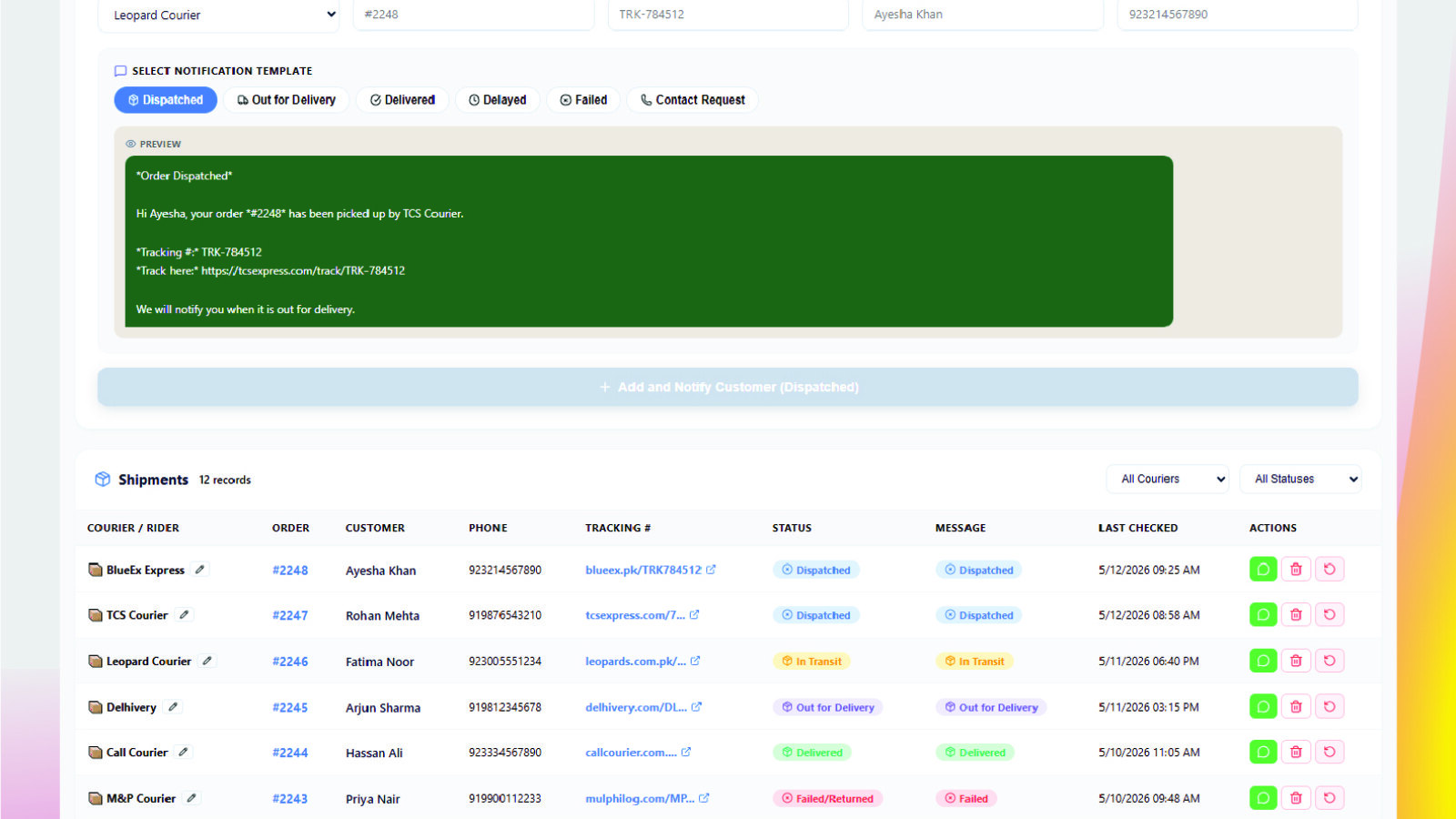
A confirmed order can still fail if the buyer is caught unaware. Notify at dispatch, notify when the parcel is out for delivery, and include the courier and tracking details. The out-for-delivery message is the important one: it tells the customer to expect a call and to have the cash ready, which removes two of the most common doorstep refusals in one message.
Method 4: Build a customer risk record and use it
Track cancellations, refusals and failed deliveries against the phone number, not the order. Once a buyer crosses a threshold you set, stop shipping to them automatically or require prepayment. This is a small number of customers producing a large share of the damage, so the fix is narrow and the saving is not.
Method 5: Reduce the time between order and delivery
Every day in transit is a day for the buyer to cool off. Faster dispatch cuts RTO on its own. Review courier performance by city too — if refusals cluster in one region, that is frequently a courier problem rather than a customer problem, and it is worth a conversation backed by your own figures.
Method 6: Nudge buyers toward prepayment
A small discount for paying online converts part of your riskiest volume into guaranteed revenue. Prepaid orders effectively cannot RTO. Even shifting 15% of orders from COD to prepaid produces a measurable drop.
Method 7: Tighten the top of the funnel
Make phone number fields validate properly. State delivery timelines clearly on the product page. If a specific ad set consistently produces high-RTO orders, its real cost per acquisition is far above what the ads dashboard reports — judge campaigns on delivered orders, not placed ones.
How ConfirmQ Reduces RTO
ConfirmQ is a Shopify app built specifically around this problem: verifying COD orders on WhatsApp before they cost you a delivery attempt. The methods above map directly onto what the app does.
Automatic confirmation at order placement. The moment a Shopify order comes in, the customer receives a WhatsApp message with confirm and cancel options. The reply is recorded against the order, so your dispatch list contains buyers who actively said yes rather than a queue of assumptions.
Follow-ups without manual work. Automation Flows let you build the chase sequence visually — a trigger, a delay, a condition on order value, and a second message — with no code. Non-responders get followed up automatically instead of being forgotten in a spreadsheet.
Delivery-stage updates. Shipment tracking sends WhatsApp notifications for Dispatched, Out for Delivery, Delivered, Delayed, Failed and Contact Request, with courier and tracking details attached. It supports Leopard Courier, TCS and custom couriers, and lets you assign riders from Shopify order tags.
Risk scoring and blocking. Fake order detection scores each customer against their own history of cancellations, returns, failed deliveries and unanswered confirmations. Cross the threshold you set and the customer can be blocked — if a blocked number orders again, you get an alert instead of a silent loss.
Reporting that shows whether it worked. Reports and Analytics brings confirmation rate, cancellation rate, returns and total failure cost into one view, with Excel export for reconciling against courier statements.
Setup is a QR code scan from the Settings screen using the WhatsApp number you already use. You can see the full workflow from checkout to delivery or browse every ConfirmQ feature.
A 30-Day Plan to Bring RTO Down
- Week 1 — measure. Calculate your current RTO rate and the cash cost of one RTO parcel. Without this baseline you cannot tell whether anything you do next helps.
- Week 2 — confirm. Turn on WhatsApp confirmation for every COD order and stop dispatching unconfirmed high-value orders. Expect cancellations to rise and RTO to fall.
- Week 3 — follow up and notify. Add an automated second message for non-responders, and switch on dispatch and out-for-delivery notifications.
- Week 4 — block and review. Set a cancellation threshold, block the repeat offenders it surfaces, and compare the month against your week-one baseline.
RTO will never reach zero on cash on delivery. But it is far more controllable than most merchants assume, and nearly all of the control sits in the window between the order being placed and the parcel leaving your warehouse. For more tactics on the returns side of the problem, see our guide on reducing COD return rates on Shopify.
Frequently Asked Questions
RTO stands for Return to Origin. It describes a parcel that was dispatched, could not be delivered or was refused by the customer, and was shipped back to the seller. The order is never paid for, and the seller absorbs shipping in both directions.
Published benchmarks vary widely by market, product category and courier, so treat them cautiously. The more useful approach is to measure your own rate for one month, then track whether it improves after you introduce order confirmation. Your own trend line is more actionable than anyone else’s average.
It addresses the largest cause of RTO, which is dispatching orders the customer never actively committed to. Asking for confirmation before packing moves failures from the doorstep, where they cost a full round trip, to the dashboard, where they cost a single message.
Not automatically. Silence is not always a refusal — plenty of buyers simply do not read the message. A practical rule is to ship unconfirmed low-value orders and hold unconfirmed high-value ones for a manual call, so you are only spending human time where the exposure justifies it.
Broad, impulse-driven campaigns reach people who were not actively shopping. Those orders convert cheaply and deliver poorly. Judge campaign performance on delivered and paid orders rather than orders placed, and the true cost per acquisition of some ad sets will look very different.
No. An RTO parcel was never accepted or paid for, so the fix belongs before dispatch. A return means the customer received the product, paid, and then sent it back, which usually points to a product page, sizing or expectation problem instead.
Ready to cut your RTO rate? ConfirmQ confirms every COD order on WhatsApp before you ship, chases non-responders automatically, and flags customers who refuse repeatedly. Install ConfirmQ from the Shopify App Store or view pricing plans.
Related: How to Stop Fake COD Orders on Shopify With WhatsApp Automation

